Guns
A Few Words About Scopes for the 10/22
found here - http://www.gunsmoke.com/guns/1022/scopes.html
There are a few things to keep in mind when choosing a scope and mount for the 10/22 rifle. While at first it might be difficult to justify spending $300 on a scope for a $150 rifle, it pays to remember that you can't hit what you can't see. Its also important to consider that even the best scopes fall victim to hard knocks and misfortune, so choose a scope from a company with a reputation for excellent service and repair.
Scope Quality vs. Cost
A 3x9 scope can be had for as little as $50 or as much as $1500. The right scope for you will balance optical quality, reliability, and price. In general terms, more expensive scopes will:
- transmit more light to your eye and will appear brighter in low light conditions
- reticle adjustments will be repeatable and free of backlash
- point of impact will not shift with scope power
- optical distortion will be minimized, even at the edges of the view
- image contrast will be higher
- there will be no unnatural color shifts
- the scope will stand up to the battering of 10/22 recoil (both reverse from firing and forward from the bolt returning to battery)
- the guarantee will increase in duration
Extra cost features that are desirable in a 22 scope are a 1" tube, adjustable focus objectives, and extended focus range. Brands to consider are Leupold, Redfield, Burris, Ziess, and Bausch & Lomb.
Magnification
Close-in rampaging pop cans require fast target acquisition and even faster follow up shots to keep things moving. Under these conditions, 3 to 4 power is plenty. At the other end of the spectrum, popping ground squirrels at 100 or more yards is facilitated by 9, 12 or even 20 power if a steady rest is at hand. And for benchrest shooting, 24, 36 and even higher magnifications may be called for.
Parallax
Parallax is an optical defect that occurs when the image does not fall on the same plane as the reticle. Parallax is detected by moving the eye up/down or side to side, causing the reticle to appear to move in relation to the target. When the scope is focused at the range of the target, parallax is eliminated. Most big game scopes are pre-focused at the factory for 100 to 150 yards, and .22 scopes at 50 to 75 yards. Adjustable focus scopes can focus as near as 10 yards, a more typical 22 LR range.
Objective Size
The trend nowadays is toward monster objective sizes: 44mm, 50mm, and even 60mm are available. A big objective lens allows more light to enter the scope, but can you really use it? Exit pupil is a measure of useful light transmission, and is calculated by dividing the objective lens size by the scope power. Under low light, the eye dilates to a maximum 5mm, so an exit pupil larger than 5mm is wasted. If you have a 50mm objective at 10X, you're right on the border. Under normal light, the pupil diameter is 3 mm or smaller, so even a 40mm objective lens at 10X transmits more light than the eye can use. So unless you plan to use the scope in low light conditions at high magnifications, save your money and go with a 32 to 40 mm objective.
Color and Finish
Dark blue or black is the traditional color for scopes, and is the one I most recommend. Silver finishes are becoming more common, but it is difficult to match the silver of the scope to that of the rings, bases, receiver, and barrel. The resulting patchwork of color more resembles a collection of scrap metal than a fine sporting arm. Several manufacturers offer dull or matte finishes to ward off reflections, but again some care is necessary to avoid unsightly mismatches.
Scope Mounts
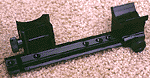
The factory supplied grooved rail is barely adequate for mounting even the lightest scope. It is prone to bending even under the softest bumps, and typical tip-off rings often slip under the recoil of the rifle. Weaver style mounts overcome this by providing a heavy notched rail through which ring mount cross bolts lock the ring to the rail. Recoil is transmitted from the receiver through the mounting screws to the rail, then through the notch shoulders to the cross bolts into the rings.
 |
 |
|
Weaver Style Rail |
Crossbolt on Underside of Low Weaver Ring |
Weaver rings are made in a range of heights to allow the scope to be positioned at varying distances above the bore of the rifle. The first concern here is to provide adequate clearance between the scope objective and the rifle barrel. The final scope height may be greater than this minimum height to achieve proper alignment of the shooter's eye behind the scope. Factors such as stock comb height, preferred position of the head on the stock, "meatiness" of a shooter's face, and intended use of the rifle may raise the scope well above the minimum height.
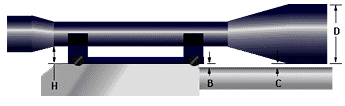
The Minimum Ring Height may be calculated as follows:
Measure objective diameter = D
Measure top of receiver to top of barrel = B
Allow 0.1" clearance between objective and barrel = C
Minimum Ring Height H > ( (D/2) - ( 0.5" + B ) )+ C
This calculation is good for 1" tube scopes.
Example:
Objective = 2.03" = D
Receiver to Top of Barrel = 0.090"
H > ( ( 2.03 / 2 ) - ( 0.5" + 0.090" ) )+ 0.1"
H > 0.525"
The answer is that ring height must be greater than 0.525", so use at least a TO-9 rail and High Rings.
| Ring/Base Combination | Distance: Receiver to Bottom of Scope Tube |
|---|---|
| TO-9 Rail & Medium Rings | 0.360" |
| TO-9 Rail & High Rings | 0.525" |
| TO-9 Rail & Extra High Rings | 0.740" |
| TO-9 Rail & See-Thru Rings | 0.925" |
| Volquartsen Receiver Base & Medium Rings | 0.685" |
| Volquartsen Receiver Base & High Rings | 0.850" |
| Volquartsen Receiver Base & Extra High Rings | 1.065" |
| Volquartsen Receiver Base & See-Thru Rings | 1.250" |
For my thin face placed forward on the stock of a 10/22T, high rings feel right and provide about 0.175" clearance between the barrel and the objective of a Leupold 3x9 Vari-X II with a 40mm objective.
Again for my face and cheek position, See-Thru rings feel right and provide about 0.440" of clearance between the barrel and the objective of a heavy barrel 10/22 and McMillan STC stock, which features a very high comb.
To get a feel for proper scope height on your rifle, try using blocks of modeling clay to "mount" your scope. Place the clay on top of the receiver where the rings would normally go, then push your scope into the clay. Keep the scope straight and parallel with the bore. Now close your eyes and shoulder the rifle. Open your eyes and see if you are looking through the scope. If not, adjust the clay until you are. Then measure the distance between the bottom of the scope tube and the top of the receiver and purchase the ring and base combination that comes closest to your measurement.